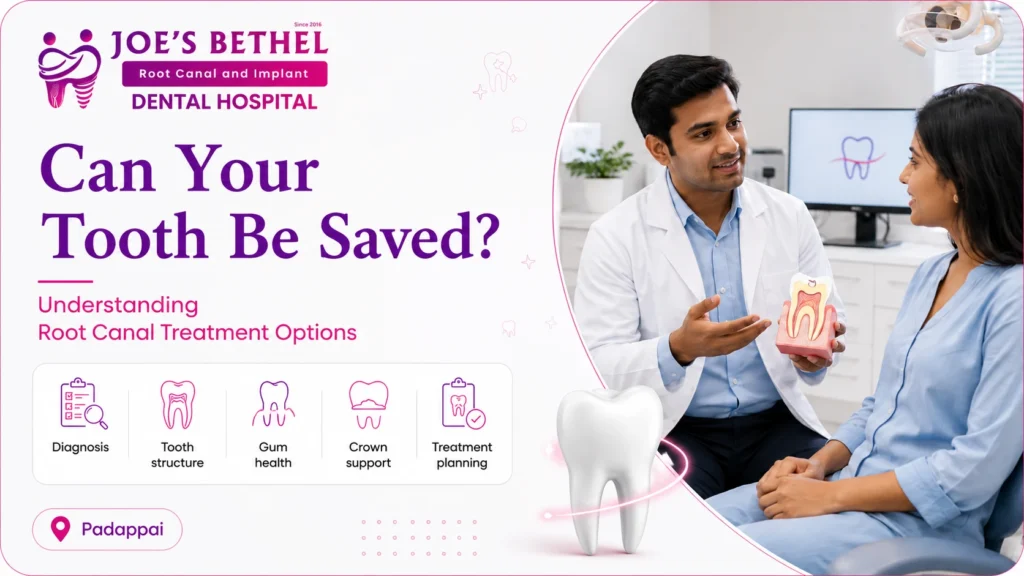
When a tooth is painful, infected, broken, or badly decayed, many patients worry that it may need to be removed. But in some cases, root canal treatment may help save the natural tooth if the tooth structure can still be restored properly.
A common question patients ask is: “Can my tooth be saved with root canal treatment?”
The answer depends on proper diagnosis. Not every painful tooth needs removal, and not every damaged tooth can be saved. Whether a tooth can be saved depends on the infection level, remaining tooth structure, gum condition, bone support, cracks or fractures, and the type of final restoration needed.
At Joe’s Bethel Root Canal and Implant Dental Clinic in Padappai, patients are guided through consultation so they can understand whether root canal treatment may be suitable for their tooth condition.
Why Saving the Natural Tooth Matters
Natural teeth are important for chewing, speaking, bite balance, and maintaining the position of nearby teeth. When a natural tooth can be treated and restored safely, saving it may be preferred over removal.
A natural tooth works with the surrounding gums, bone, and bite system. Removing a tooth may sometimes lead to spacing issues, chewing difficulty, and the need for tooth replacement options such as a dental implant, bridge, or denture.
However, saving a tooth is only advisable when it can be restored properly and function safely. The dentist must assess whether the tooth has enough support and structure before recommending root canal treatment.
What Root Canal Treatment Does
Root canal treatment is commonly done when infection or inflammation affects the inner part of the tooth. The inner part, called the pulp, contains nerves and blood vessels. Deep decay, cracks, trauma, or repeated dental problems can affect the pulp and cause pain, sensitivity, swelling, or infection.
During root canal treatment, the infected or inflamed tissue inside the tooth is removed. The canals are cleaned, shaped, disinfected, filled, and sealed. After this, the tooth usually needs a filling, core build-up, or crown depending on the remaining tooth structure.
The goal is to treat the source of infection and preserve the natural tooth when suitable.
Signs Your Tooth May Still Be Restorable
Only a dentist can confirm whether a tooth can be saved, but some signs may suggest that saving the tooth could be possible after evaluation.
Enough Tooth Structure Remains
If enough natural tooth structure remains above the gumline, the tooth may be restorable after root canal treatment. The dentist will check whether a filling or crown can be placed securely.
The Tooth Is Not Severely Cracked
A small crack or damaged area may sometimes be managed depending on its position and depth. However, cracks that extend deep below the gumline may affect whether the tooth can be saved.
Gum and Bone Support Are Stable
A tooth needs healthy surrounding gums and bone for long-term support. If gum health and bone support are stable, root canal treatment and restoration may be considered.
Infection Can Be Managed
If infection is limited and the tooth can be cleaned and sealed properly, root canal treatment may be suitable. In more complex cases, the dentist may explain additional steps or alternative options.
Signs a Tooth May Be Badly Damaged
Sometimes a tooth may be too damaged to save safely. This does not mean every painful tooth must be removed, but it does mean diagnosis is important.
A tooth may be difficult to save if:
- There is very little tooth structure left
- A crack extends deep below the gumline
- The tooth has severe mobility
- Bone support is poor
- The tooth is fractured in a way that cannot be restored
- Infection has caused major damage around the root
- The tooth cannot support a final restoration
In such cases, the dentist may discuss tooth removal and replacement options.
How Deep Decay Affects Treatment Decisions
Deep decay is one of the common reasons patients need root canal treatment. If decay reaches the pulp, the tooth may become painful, sensitive, or infected.
If the tooth still has enough structure after removing decay, root canal treatment followed by a proper restoration may be considered. But if decay has destroyed too much of the tooth, saving it may be more difficult.
This is why early diagnosis matters. A cavity that is checked earlier may be easier to restore than one that is left untreated for a long time.
How Cracks or Fractures Affect Whether a Tooth Can Be Saved
Cracks and fractures can make treatment decisions more complex. A tooth with a small crack may sometimes be restored, but a tooth with a deep vertical fracture may not be suitable for root canal treatment.
The dentist will examine the tooth, check symptoms, and may use X-rays or other diagnostic methods to understand the extent of the crack. Pain while biting, sensitivity, or repeated swelling may be signs that a cracked tooth needs evaluation.
Why Gum Health and Bone Support Matter
Even if root canal treatment is successful inside the tooth, the tooth still needs support from the surrounding gums and bone. Gum disease, bone loss, or severe tooth mobility can affect whether the tooth can function properly after treatment.
A dentist will check gum condition, pocket depth if needed, bone support, and tooth stability before deciding whether the tooth can be saved.
Why X-Rays and Diagnosis Are Important
X-rays help the dentist see what is not visible during a basic examination. They can show deep decay, infection around the root, bone changes, root shape, and other details that help in treatment planning.
Diagnosis may include:
- Checking symptoms
- Examining the tooth structure
- Testing sensitivity
- Assessing bite pressure
- Checking gum condition
- Reviewing X-rays
- Evaluating restoration needs
This helps the dentist decide whether root canal treatment, extraction, or another treatment option is suitable.
Why a Crown May Be Needed After Root Canal Treatment
After root canal treatment, some teeth become weaker because of deep decay, cracks, or loss of tooth structure. A crown may be recommended to protect the tooth during chewing.
Back teeth often handle more chewing pressure, so they may need crowns more commonly after root canal treatment. The dentist will advise based on how much tooth structure remains and where the tooth is located.
Skipping the final restoration can affect the treated tooth, so follow-up care is important.
Root Canal Treatment vs Tooth Extraction
Root canal treatment and tooth extraction are different treatment paths. Root canal treatment aims to save the natural tooth when it can be restored. Tooth extraction may be considered when the tooth is too damaged, fractured, loose, or unsupported to be saved safely.
If extraction is needed, tooth replacement options may be discussed, such as dental implants, bridges, or dentures. As a root canal and implant-focused clinic, Joe’s Bethel can guide patients on both saving a tooth and replacing a missing tooth when needed.
When to Visit a Dentist for Tooth Pain, Swelling, or Sensitivity
You should consider visiting a dentist if you have:
- Tooth pain while chewing
- Sensitivity that lingers
- Swelling near the gums
- Deep decay or broken tooth
- Pain that worsens at night
- Gum boil or pus discharge
- A cracked tooth
- Pain that keeps returning
Patients from Padappai and nearby areas such as Tambaram, Oragadam, Mannivakkam, Vandalur, Sriperumbudur, Guduvanchery, and Mudichur can visit for consultation if they are experiencing tooth pain, swelling, or sensitivity.
How Consultation Helps You Understand Whether Your Tooth Can Be Saved
A consultation helps patients understand the real condition of the tooth. Instead of guessing based on pain, the dentist can examine the tooth and explain what is possible.
During consultation, patients can ask:
- Is my tooth infected or inflamed?
- Can the tooth be saved with root canal treatment?
- Is there enough tooth structure left?
- Is the tooth cracked or fractured?
- Will I need a crown after treatment?
- What happens if the tooth cannot be saved?
This helps patients make informed decisions with clarity.
Book a Root Canal Consultation in Padappai
If you are worried that your tooth may need removal, a dental consultation can help you understand whether root canal treatment may be suitable. The dentist can assess infection level, tooth structure, gum health, bone support, cracks, and restoration needs.
At Joe’s Bethel Root Canal and Implant Dental Clinic in Padappai, patients receive guidance based on diagnosis and tooth condition.
Want to know if your tooth can be saved?
Book a consultation at Joe’s Bethel Root Canal and Implant Dental Clinic in Padappai to understand your tooth condition and whether root canal treatment may be suitable.
Book AppointmentFAQs
1. Can every tooth be saved with root canal treatment?
No. Root canal treatment may help save a tooth when the tooth has enough remaining structure, stable support, and can be restored properly. Some badly damaged or fractured teeth may need removal.
2. How does a dentist decide if my tooth can be saved?
The dentist checks infection level, remaining tooth structure, gum health, bone support, cracks, X-rays, and whether the tooth can support a final restoration.
3. Does tooth pain mean the tooth must be removed?
No. Tooth pain does not always mean removal is needed. Some painful teeth may be treated with root canal treatment or other care, depending on diagnosis.
4. Why might I need a crown after root canal treatment?
A crown may be recommended when the tooth is weak, cracked, heavily decayed, or used for chewing. It helps protect the treated tooth after root canal treatment.
5. Where can I check if my tooth can be saved in Padappai?
You can visit Joe’s Bethel Root Canal and Implant Dental Clinic in Padappai for consultation. The dentist can examine your tooth and explain whether root canal treatment may be suitable.